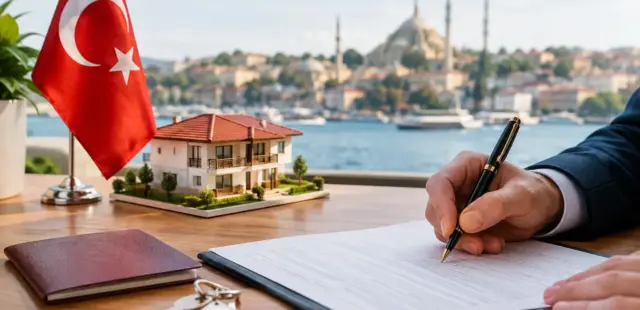


An apartment by the sea in Alanya, a villa in Bodrum, or an apartment in Dubai no longer requires several trips, a trusted notary in another country, and months of uncertainty. Understanding how to buy property online, an investor can choose a property, verify the documents, sign the contract, and obtain ownership remotely. However, the online format does not eliminate thorough due diligence — on the contrary, it makes it the key condition of a safe transaction.
For buyers from Ukraine, Europe, the USA, or CIS countries, this is an opportunity to invest in resort real estate without being tied to their place of residence. At the same time, a remote purchase should not be a “booking based on beautiful photos,” but a controlled process with clear documents, a financial model, and defined responsibility for each party.

When Buying Property Online Is Truly Justified
The remote format works best when the purpose of the purchase is defined before the search begins. For personal use, infrastructure, layout, quality of the complex, proximity to the sea, schools, or a marina are important. For rental purposes, seasonality, management company rules, maintenance costs, and real demand in a specific location come first. An investor planning to resell evaluates the construction stage, developer reputation, pace of district development, and liquidity of comparable properties.
An online transaction is particularly convenient for completed apartments in well-known complexes, where it is easy to compare layouts, prices, and sales history. It is also suitable for verified new developments if the developer has the required permits, a clear payment schedule, and transparent terms for transferring the property.
However, a personal visit can still be valuable. For example, if you are choosing an expensive villa, an area for permanent relocation, or a property with an unusual plot. In such a situation, an online viewing can be the first stage, while an inspection tour provides final confirmation of the decision. This is not distrust of the remote format, but sensible management of significant capital.
How to Buy Property Online: From Application to Keys
A reliable remote transaction begins not with a deposit transfer, but with an interview. The agent needs to know your budget, preferred country, settlement currency, investment horizon, need for a residence permit or citizenship, and expectations regarding rental income. Only then should a selection be prepared instead of sending a dozen random catalogue options.
1. Choose Not Just an Apartment, but an Investment Scenario
Ask for a comparison of several properties using the same parameters: total price, area, construction stage, views, annual expenses, projected rental rate, taxes, and resale potential. The price shown on a website or in a presentation does not always equal the final budget. Taxes, registration fees, translator services, insurance, furniture, and the complex’s monthly service fee may be added to it.
In resort regions, ask whether short-term rentals are permitted, who will handle guests, how income is distributed, and which months are considered low season. A promised return of up to 12% may be realistic for certain formats and locations, but it is not a universal guarantee. Net income depends on occupancy, management fees, taxes, repairs, and currency exchange rates.
2. Conduct a Video Viewing as If You Were at the Property
A quality online viewing is not a pre-recorded drone video. Ask the agent to conduct a live tour: show the entrance, lobby, elevator, grounds, route to the beach or city centre, the view from each room, noise levels, the condition of bathrooms, balconies, and technical areas. For a new development, it is appropriate to see the construction site, progress of work, completed buildings, and finished projects by the same developer.
Ask practical questions. Which direction do the windows face? Could future construction block the view? What is the ceiling height? Are appliances included? Does the complex operate during winter? Are there restrictions on owners renting out their apartments? These details determine both living comfort and asset liquidity.
3. Check the Legal Status Before Transferring Funds
Each country has its own registration procedure, but the logic of due diligence is the same. You need to establish who the legal seller is, whether they have the right to dispose of the property, and whether there are encumbrances, debts, arrests, mortgages, or disputes. For a new development, check the developer’s rights to the land, the construction permit, contract terms, and the status of commissioning.
Documents should be translated into a language you understand. Pay particular attention to clauses concerning deadlines, penalties, deposit refunds, specifications, force majeure, and dispute resolution. Do not accept statements such as “everything is standard” if you have not seen the standard contract.
It is important for the buyer that funds are transferred transparently: to the account specified in the contract, with the payment purpose properly documented. Transfers to personal cards, urgent demands to pay “today only,” and refusal to provide documents are sufficient reasons to pause negotiations.
4. Arrange a Power of Attorney and Sign the Documents
If the legislation of the country allows remote property purchases, the buyer can issue a special power of attorney to a representative. It should be limited to the specific transaction and contain the property details, list of powers, signing authority, and the ability to pay taxes and register ownership. A universal power of attorney without clear limits creates unnecessary risks.
Depending on the jurisdiction, the document may be executed before a notary, legalized or apostilled, translated, and delivered to the representative. Some contracts can be signed electronically, but registration procedures often require originals or the participation of an authorized person. It is critical that the agent, lawyer, and notary work according to the same plan and that the buyer understands which document is being signed at each stage.
5. Control Ownership Registration, Not Just Contract Signing
A signed contract does not always mean that you have become the owner. The transaction is completed when ownership is registered in the state register and a document confirming it is obtained. In Turkey, this key document is the TAPU; other countries have their own registration systems.
After registration, it is advisable to obtain scans and originals of all documents, payment confirmations, the technical passport, keys or access codes, and agreements with the management company. If the property is purchased for rental purposes, immediately determine who will furnish the apartment, take professional photographs, list it on rental platforms, and report on the income.
Risks That Cannot Be Ignored
The most common mistake is evaluating property solely by the price per square metre. An inexpensive apartment may prove illiquid because of its distance from the sea, weak infrastructure, high maintenance fees, or an excess of similar properties in the area. A more expensive property in a strong complex can sometimes sell faster and generate more stable rental demand.
The second risk is currency. Income, expenses, and the value of the asset may be denominated in different currencies. Therefore, the investment calculation should be made not only in the local currency but also in the currency of your capital. The third is immigration-related: investment thresholds for residence permits or citizenship, lists of eligible areas, and document requirements may change. Do not purchase a property based solely on an advertising promise of a passport or residence permit.
Be equally cautious with capital appreciation forecasts. A price increase of up to 40% is possible at the early stage of strong projects, but it depends on the market, construction timeline, demand, and overall economic conditions. A professional approach involves several scenarios: optimistic, base, and conservative.
What International Agency Support Provides
Buying independently may seem like a way to save on commission, but it often increases the cost of a mistake. The buyer has to compare developers, coordinate translations, bank payments, lawyers, powers of attorney, and property handover independently. It is especially difficult to control the process when you are in another time zone.
Turkey Property Group structures the remote transaction as a sequence of control points: from investment selection and online viewing to documentation, registration, and post-sale service. More than 1,600 properties in the database make it possible not to tie the client to a single developer, while experience assisting more than 950 clients helps identify questions that usually arise only after the deposit has been paid.
Buying property online can be fast: with properly prepared documents, the average transaction cycle can sometimes be completed in approximately 20 days. But speed should be the result of good organization, not pressure. Start not with choosing the most spectacular sea view, but with an honest answer to the question of why you need this asset in three to five years. Then property abroad will become not just a beautiful purchase, but a well-considered part of your life and capital.