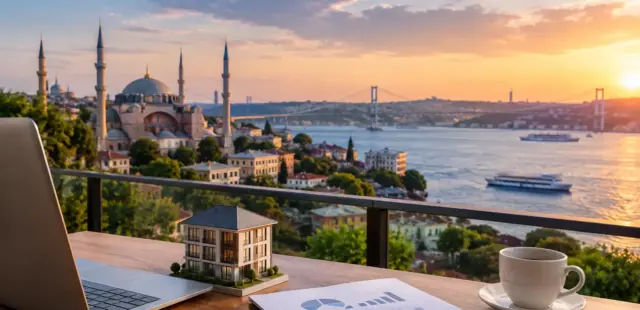

Istanbul is not like a classic resort market where the main arguments are sea views and summer demand. It is a 16-million-person metropolis, Turkey’s financial and cultural center, a city spanning two continents and home to major infrastructure projects. That is why the Istanbul real estate market is of interest not only to buyers looking for a home to relocate to, but also to investors who need an asset with deep rental demand, capital appreciation potential, and a clear exit strategy.
However, there is no universal answer to the question of “where to buy.” An apartment in the historic center, a residence near a business district, and a family property in a new neighborhood operate according to different principles. A successful purchase starts not with a beautiful development render, but with a clearly defined goal, investment currency, and holding period.

What Shapes the Istanbul Real Estate Market
Istanbul has diversified demand. Local families, senior executives of international companies, students, expats, entrepreneurs, and foreign investors all buy housing here. This tenant base makes the city less dependent on a single tourist season. At the same time, it raises the requirements for a property: liquidity is determined not simply by the district, but by transport accessibility, construction quality, developer reputation, layout, and the actual rental audience.
Prices are influenced by inflation in Turkey, fluctuations of the lira, limited land supply in central locations, and the development of the transport network. Metro lines, Marmaray, new business districts, and projects on the Asian side of the city are changing the map of demand faster than traditional tourist rankings. For a buyer with capital in dollars or euros, it is important to analyze the transaction in hard currency: an increase in the price in lira does not always mean the same result in dollars.
New developments form a separate segment. Developers offer installment plans, gated grounds, security, parking, fitness centers, and services that are especially convenient for remote owners. However, the premium for a new complex must be justified. If dozens of similar buildings are being completed in the same area at the same time, competition for tenants and resale buyers can reduce actual returns.
Istanbul Districts: The Choice Depends on the Goal
For Prestige Living and Capital Preservation
Beşiktaş, Nişantaşı, Etiler, Arnavutköy, Sarıyer, and selected Bosphorus locations form the premium segment. Here, buyers value proximity to the business center, restaurants, international schools, yacht infrastructure, and panoramic views. Such properties are scarce, and high-quality housing continues to attract affluent buyers.
The compromise is obvious: the entry budget is high, while rental returns in percentage terms are often lower than in the mass-market segment. This is primarily a strategy for capital preservation, personal comfort, and a long-term horizon rather than a purchase aimed at maximizing monthly rental income.
For Business Rentals and an Urban Lifestyle
Şişli, Kağıthane, Maslak, Levent, and districts near key metro hubs are attractive to professionals working in business clusters. Here, the key factor is not proximity to the water but travel time. Compact apartments with functional layouts, a quality management company, and access to the metro often have more stable demand for long-term rentals.
Investors should compare not the advertised rental rate, but the net result after monthly complex maintenance fees, insurance, furnishing, taxes, and vacancy periods. In large residences, a high aidat — the fee for maintaining shared infrastructure — can significantly affect the economics of an apartment.
For Families and Long-Term Potential
Bahçelievler, Beylikdüzü, Başakşehir, Ümraniye, and some parts of Kartal and Maltepe offer more space for the same budget, modern complexes, and family infrastructure. The Asian side, including Kadıköy, Ataşehir, Üsküdar, Kartal, and Pendik, attracts buyers with a calmer pace of life, waterfront areas, and a high-quality urban environment.
Here, it is important not to apply the logic of a resort purchase to Istanbul. A complex far from the metro with a large swimming pool may look impressive in a presentation but lose to an ordinary building within walking distance of public transport, schools, and shops. For family-oriented properties, seismic resistance, documentation, schools, hospitals, and daily logistics become decisive factors.
New Development or Resale Property
A new development is suitable for those who want a modern standard of living, an installment plan from the developer, and potential price growth during construction. In a strong project, capital appreciation before completion can be significant, but it is not guaranteed. It is necessary to check permits, the payment schedule, the developer’s previously completed projects, and the number of comparable apartments currently for sale.
Resale property offers a different advantage: the buyer can see the actual building, neighbors, view from the window, maintenance costs, and actual rental rates. A completed apartment can be registered, furnished, and transferred to management more quickly. Its weak point is its technical condition, building age, and possible renovation costs, so due diligence before the transaction is mandatory.
In Istanbul, seismic safety is not a formality. The year of construction, compliance with current standards, technical inspection, land status, and the availability of a complete Tapu — the title deed — should all be part of the decision before any deposit is paid.
How to Calculate Returns Without Inflated Expectations
Advertised returns of up to 12% may be achievable for certain property formats, but they should not be considered the standard for every apartment. The final figure depends on the purchase price, rental model, currency, furnishing costs, and quality of management. Long-term rentals are generally more predictable, while short-term rentals can generate higher gross income but require active management and depend on the current rules of the district and complex.
A proper financial model answers three questions: how much the property costs “turnkey,” what net income it generates after expenses, and at what price it can realistically be sold in three to five years. The budget should include government fees, translator services, valuation, insurance, furniture, utility connections, taxes, and annual complex fees.
If the goal is capital diversification, it is better to choose apartments with a broad pool of potential buyers rather than a highly specific property. A liquid size, understandable layout, transport access, and strong location are often more important than excessively expensive finishes or a high-profile project name.
Residence Permit and Citizenship: Do Not Confuse the Goals
Purchasing real estate may provide grounds for obtaining a residence permit if current legal requirements and the status of the district are met. At the same time, not every property or location is equally suitable for this scenario: certain districts may have restrictions for new applicants, and the rules can change.
An investment under a government program may also provide a path to Turkish citizenship. Historically, the key benchmark was an amount starting from USD 400,000 with a restriction on selling the property for a specified period, but the conditions must be confirmed under the current regulations before the transaction. For this purpose, the property valuation, non-cash payment process, correct documentation package, and legal support at every stage are critically important.
How to Make the Transaction Manageable
Buying property in another country should not turn into an independent search through hundreds of listings. A practical route starts with a financial profile: budget, currency, goal, holding period, and the need for a residence permit or citizenship. A shortlist is then created by comparing locations, actual entry prices, rental scenarios, and risks.
After viewing the property — in person or online — legal and technical due diligence should be carried out, the payment schedule agreed upon, and only then should the property be reserved. At Turkey Property Group, clients are assisted throughout the process, from investment selection and remote transactions to transferring the apartment into management. The average preparation cycle for a transaction can take around 20 days, but speed should never replace document verification.
Istanbul rewards not those who buy the cheapest property, but those who choose an asset according to their own objective. Start with an honest answer about what your result should be in several years: a family home, stable rental income, a second home by the Bosphorus, or an asset for obtaining a new status. This answer will narrow a vast market down to several genuinely suitable addresses.